 QuickBooks · Aug 16th 2026 · 7 Min read
How to Reconcile Account in QuickBooks Online?
Your bank statement just closed. You have 47 transactions in QuickBooks Online and a nagging suspicion that the ending balance won’t match. That suspicion is exactly why monthly reconciliation exists — and why skipping it for even one period turns a 20-minute task into a multi-hour forensic exercise.
This guide walks you through the full reconciliation workflow in QuickBooks Online, flags the spots where people stall, and explains what to do when the difference column refuses to hit $0.00.
What You Need Before You Start
Pull your bank or credit card statement for the period you’re closing. You need two numbers from it: the ending balance and the statement end date. Everything else — your transactions — should already be recorded in QuickBooks Online before you open the reconcile screen.
If you’re catching up on multiple months, work chronologically. Reconciling March before February is reconciled will create cascading discrepancies that are painful to untangle. QuickBooks Online’s documentation specifically recommends hiding transactions after the statement end date when working through a backlog — use that filter to keep each period clean.
Step-by-Step: Reconcile an Account in QuickBooks Online
Step 1 — Open Reconcile
Go to All apps > Accounting > Reconcile. If this is your first reconciliation on this account, you’ll see a Get started button instead of the standard screen. Click it.
Step 2 — Select Your Account and Verify the Starting Point
From the Account dropdown, choose the bank or credit card account you’re reconciling. Confirm it matches the statement in your hand — not a similar-named account. Before entering anything, check the Last statement ending date shown on screen. Your current statement should start the day after that date. If it doesn’t, you have a gap or overlap to address before continuing.
Step 3 — Enter Ending Balance and Ending Date
Type the Ending balance and Ending date exactly as they appear on your statement. No rounding. No approximations. If you’re using QuickBooks Online’s Upload or Statement Auto Import feature, the system can populate these fields automatically after the file is verified — that process can take up to an hour, so don’t trigger it if you’re on a deadline.
Click Start reconciling.
Step 4 — Match Transactions
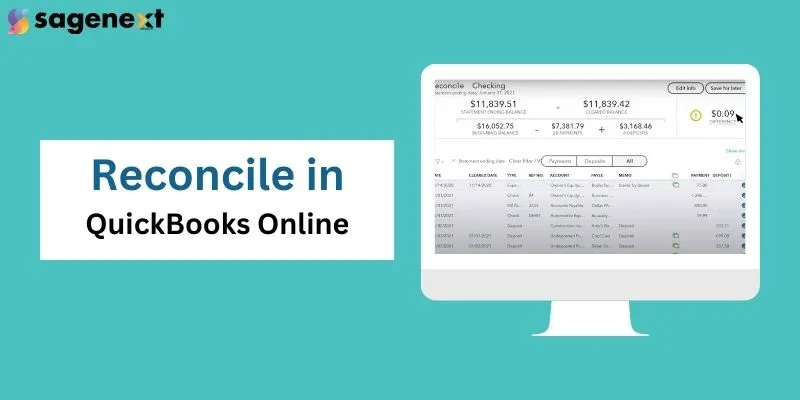
The reconciliation screen shows your QuickBooks transactions side by side with what should be on your statement. Check the box next to each transaction that appears on your bank statement. Work top to bottom. Use the date and amount filters to narrow the list if you’re dealing with a high-volume account.
Watch the Difference figure at the top of the screen. You’re done when it reads $0.00.
A few things that commonly prevent that $0.00:
- A transaction entered with the wrong amount (a $1,200 payment recorded as $1,020 is the classic transpose error)
- A duplicate transaction from a bank feed import
- A transaction dated outside the statement period that got checked anyway
- An outstanding check that the bank hasn’t cleared yet — leave it unchecked and it will appear next month
The Insights tab, available during the reconcile workflow, shows a statement comparison summary. Use it to quickly spot whether the discrepancy is on the deposit side or the payments side.
Step 5 — Finish the Reconciliation
Once the Difference shows $0.00, click Finish now, then Done. QuickBooks Online saves the reconciliation report automatically. You can access it later under Reports > Reconciliation Reports if a client or auditor asks for documentation.
When the Difference Won’t Zero Out
Don’t force it by creating an adjusting entry unless you’ve exhausted the actual fixes. The most productive debugging sequence:
- Compare the total of cleared deposits in QBO against your statement’s deposit total. If those match, the problem is in payments.
- Sort by amount and look for the exact discrepancy dollar amount — a single transaction that equals the difference is usually the culprit.
- Check whether a transaction was reconciled in the wrong period. A prior-period reconciliation that was altered after the fact will throw off the current opening balance.
If you’re consistently off by small amounts, bank fees and interest charges are often the cause — they post automatically at month-end and get missed if you’re not pulling a final statement.
Multi-Month Catch-Ups
If a client comes to you with six months of unreconciled accounts, resist the urge to reconcile them all against the most recent statement. QuickBooks Online’s documentation is clear: work one statement period at a time, and hide transactions after each statement’s end date so you’re only seeing what actually cleared in that window. It takes longer upfront, but you’ll catch the problem transactions rather than burying them.
How Sagenext Helps
If your firm runs QuickBooks Online or QuickBooks Desktop across multiple staff members, the underlying infrastructure matters more than most people realize.
Sagenext hosts QuickBooks and other accounting applications on a fully managed cloud platform. Your team accesses the same file from any location through a secure remote desktop session, without anyone managing software updates, backups, or access controls. For a firm where two bookkeepers are reconciling different client accounts simultaneously, that kind of centralized, managed access eliminates the version conflicts and file-lock errors that slow down month-end close. A free trial is available with no credit card required — worth testing before your next busy season.
Key Takeaways
- Open reconciliation via All apps > Accounting > Reconcile and always verify the Last statement ending date before entering new data.
- Enter the ending balance and ending date from your physical or digital statement exactly — small typos here cause hard-to-trace discrepancies.
- Check transactions one by one until the Difference field shows $0.00, then click Finish now and Done.
- Use the Insights tab to identify whether a discrepancy is on the deposit or payment side.
- For multi-period catch-ups, reconcile one statement at a time and filter out transactions after each period’s end date.
- Outstanding checks and automatic bank fees are the two most common reasons a reconciliation won’t close cleanly on the first pass.
Frequently Asked Questions
Where is the Reconcile option in QuickBooks Online?
Go to All apps, then select Accounting, then Reconcile. If you’ve never reconciled this account before, you’ll see a Get started button on that screen. Intuit occasionally reorganizes the navigation menu, so if you don’t see Accounting in the left sidebar, check under the Apps menu or use the global search bar to find Reconcile directly.
What if my opening balance in QuickBooks Online doesn’t match my bank statement?
Check whether a previously reconciled transaction was edited or deleted after the fact. QuickBooks Online will flag this if you look at the reconciliation history report. Restoring the original transaction — or re-entering it correctly — usually fixes the opening balance discrepancy without requiring a manual adjustment entry.
Can QuickBooks Online auto-fill the ending balance during reconciliation?
Yes. If you use the Upload or Statement Auto Import feature to bring in your bank statement file, QuickBooks Online can automatically populate the ending balance and ending date fields. Be aware that verification after upload can take up to an hour, so don’t rely on this option for last-minute closes.
Do I need to reconcile credit card accounts separately from bank accounts?
Yes. Each account — checking, savings, and every credit card — requires its own reconciliation against its own statement. The process is identical for all account types in QuickBooks Online. Select the specific account from the dropdown and match it against the corresponding statement.
What happens if I click ‘Finish now’ before the Difference reaches $0.00?
QuickBooks Online will warn you that the reconciliation is out of balance and offer to create an adjusting entry to force it closed. Avoid accepting that offer unless you’ve genuinely exhausted every other option. An adjusting entry hides the real problem and will resurface as an unexplained variance in future periods. Take the extra time to find the source of the discrepancy first. Intuit has detailed troubleshooting documentation for common reconciliation errors. You can also review your firm’s historical reconciliation patterns by checking Top AI Tools For QuickBooks Desktop for additional QuickBooks workflow guidance.