 QuickBooks · Jul 15th 2026 · 7 Min read
How to Undo Reconciliation in QuickBooks Online | 2026 Guide
Your client calls on a Friday afternoon: their bank reconciliation closed with a $400 discrepancy, and now you realize a payment was posted to the wrong account two months ago. You need to undo that reconciliation without wrecking everything downstream. Here’s exactly how to do it.
What ‘Undoing’ Actually Means in QBO
QuickBooks Online tracks reconciliation status in the checkmark column of every register. Each transaction sits in one of three states: R (Reconciled), C (Cleared), or blank (Uncleared). When you undo a reconciliation, you’re rolling one or more transactions back from R to C or blank so they re-enter the unreconciled pool.
There are two distinct methods — one for the full period, one for individual transactions — and which you can use depends on how you’re accessing the file.
Method 1: Undo an Entire Reconciliation (Accountants Only)
This method is only available when you open the client’s company file through QuickBooks Online Accountant. If you’re logged in as a regular user or admin, the Undo option won’t appear. That’s not a bug — Intuit restricts full-period undos to accountant-access logins by design.
Step 1. In the client’s QBO file, go to Accounting in the left nav, then click the Reconcile tab.
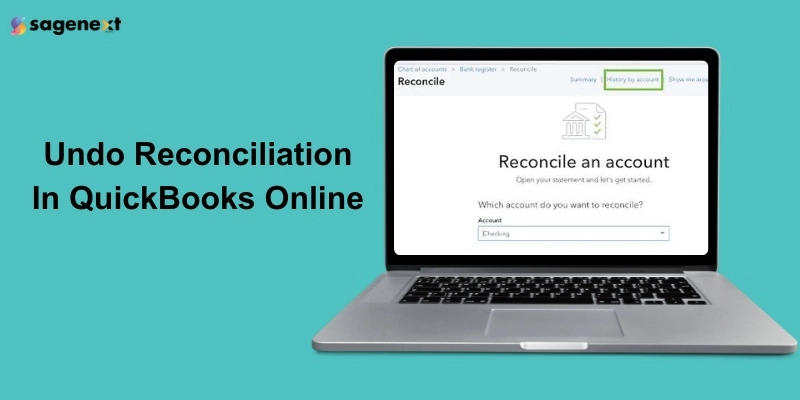
Step 2. Click History by account (top right of the Reconcile screen).
Step 3. Use the account and date-range filters to find the reconciliation period you need to reverse.
Step 4. Locate the specific reconciliation entry in the list.
Step 5. Click View Report to confirm you have the right period — check the ending balance and statement date against your bank statement before committing.
Step 6. Back in the History by account list, click the dropdown arrow in the Action column next to that reconciliation entry and select Undo.
Step 7. A confirmation dialog appears. Click Yes, then Undo again to confirm. QBO will mark every transaction in that period as Cleared (C) rather than Reconciled (R), effectively reopening the period.
After the undo completes, fix whatever caused the discrepancy — correct the misposted transaction, delete the duplicate, or add the missing entry — then re-run the reconciliation for that period.
> Missing the Undo button? You’re almost certainly viewing the file through a standard QBO login, not QBO Accountant. Switch access methods first. Intuit
Method 2: Unreconcile Individual Transactions Manually
If you only need to pull one or two transactions out of a closed reconciliation — say, a split transaction that was reconciled in the wrong period — the manual method is faster and carries less risk than undoing the full period.
Step 1. Go to Settings (gear icon) > Chart of Accounts.
Step 2. Find the account containing the transaction, then click View register.
Step 3. Scroll to locate the transaction. In the checkmark column, you’ll see R for any reconciled item.
Step 4. Click the R once — it cycles to C (Cleared). Click it again — it goes blank (Uncleared). Stop at whichever status is appropriate. For most corrections, leaving it blank so it re-enters the open reconciliation is the right call.
Step 5. Click Save.
Repeat for each transaction you need to unreconcile. This approach leaves all other reconciled periods intact, which matters when you’re dealing with a client whose books go back several years and you don’t want to cascade changes across multiple closed periods.
When to Use Which Method
| Situation | Best approach |
|---|---|
| Wrong ending balance on a closed period | Full undo via QBO Accountant |
| One or two transactions in wrong account | Manual transaction-level unreconcile |
| Regular QBO user (no Accountant access) | Manual only — full undo unavailable |
| Multiple periods affected | Full undo, oldest period first |
If you need to undo multiple consecutive periods, work backward — undo the most recent period first, then the one before it. Trying to undo an older period while a newer reconciliation still references it creates a cascade of balance errors.
Three Mistakes That Cause Reconciliation Headaches
1. Reconciling before bank feeds finish importing. If transactions are still pending, you’ll close a period with gaps. Wait until the feed is current before clicking Finish.
2. Editing reconciled transactions instead of creating adjusting entries. Changing the amount or date on an R-marked transaction silently breaks your reconciliation. Create a journal entry or correcting transaction instead, then re-reconcile.
3. Multiple staff reconciling the same account. Without proper access controls, two people can modify reconciled items independently. Assign a single owner to each account’s reconciliation process.
How Sagenext Helps
Most reconciliation errors in multi-staff firms trace back to one root cause: the wrong person edited a transaction the night before month-end close, and nobody caught it until the partner reviewed the financials.
Sagenext hosts QuickBooks on a managed cloud environment where every team member accesses the same live file through a secure remote desktop session — no local copies, no version mismatches, no one working off a downloaded backup. Automatic backups run on a schedule Sagenext controls, so if you need to roll back to yesterday’s state to investigate a reconciliation discrepancy, that snapshot exists. For firms juggling multiple client files across QBO and QuickBooks Desktop, having a single managed platform with consistent access controls reduces exactly the kind of ad-hoc edits that turn reconciliations into Friday-afternoon fire drills.
Sagenext offers a free trial with no credit card required.
Key Takeaways
- Full-period undo is only available through a QuickBooks Online Accountant login — regular users cannot access it.
- The Undo option lives in the Action column dropdown under Accounting > Reconcile > History by account.
- Individual transactions can be manually unreconciled by cycling the R status to blank in the Chart of Accounts register.
- Always fix the underlying error before re-running the reconciliation — undoing alone solves nothing.
- When undoing multiple periods, start with the most recent and work backward.
- Consistent access controls and automated backups prevent most reconciliation errors before they start.
Frequently Asked Questions
Can a non-accountant user undo a full reconciliation in QuickBooks Online?
No. The full-period Undo option only appears when you access the client file through QuickBooks Online Accountant. If you’re logged in as a company admin or standard user, that option is hidden by design. Your only option as a regular user is to manually change individual transaction statuses from R to blank in the Chart of Accounts register — a workable fix for a few transactions, but tedious for an entire period.
What happens to my data after I undo a reconciliation?
QBO changes every reconciled transaction in that period from R (Reconciled) back to C (Cleared). The transactions themselves — amounts, dates, payees — are untouched. Only their reconciliation status changes. You’ll need to re-reconcile the period after correcting whatever caused the original error.
Why is the Undo button missing in my History by account view?
Almost always, you’re viewing the file through a standard QBO login rather than QBO Accountant. Open the same client file from your QuickBooks Online Accountant dashboard and the Undo option will appear in the Action column dropdown. If you don’t have an accountant login, you’ll need to unreconcile transactions one by one manually.
Can I undo reconciliations for multiple periods at once?
No — QBO requires you to undo one period at a time. If several consecutive periods are affected, undo the most recent period first, correct the error, then work backward through earlier periods. Undoing in reverse chronological order prevents cascading balance discrepancies across your reconciliation history.
What’s the difference between Cleared (C) and Reconciled (R) status?
Cleared (C) means a transaction has been matched to a bank statement but the reconciliation period hasn’t been officially closed. Reconciled (R) means the period was closed and the transaction is locked into that reconciliation. A blank status means the transaction hasn’t been matched to any bank statement at all. When you undo a reconciliation, R items revert to C — they’re still matched, just no longer tied to a closed period. Troubleshooting QuickBooks Bank Reconciliation Problems